
Phunchuk Stobdan's forte was candour and strong views on India's defence. Naturally, India's adversaries were in awe of him, fearing his views and unyielding stand on boundary issues, remembers Tarun Vijay.

The United States' historical strategic alignment with Pakistan, dating back to the Cold War, has consistently aimed to create a political and military parity with India, despite India's significantly larger size and resources. This long-standing relationship continues to influence regional dynamics, particularly in West Asia and the Indo-Pacific.

The 15th India-Vietnam Defence Dialogue signalled a move from routine talks to deeper cooperation, with new deals on submarine rescue and defence industry to support stability in the Indo-Pacific, notes Dr Rajaram Panda.

According to the Justice Department, Tellis, 64, the Tata Chair for Strategic Affairs and a senior fellow at the Carnegie Endowment think-tank, served as an unpaid senior adviser to the State Department and was also a contractor with the Office of Net Assessment at the Department of Defense.

'The tools of warfare are changing. The MoD must deepen its engagement with technology thinkers that can present compelling visions of where warfare may be heading.'

The enduring relationship between the two countries have survived the disintegration of the erstwhile USSR in 1991, the end of the Cold War and the regime change in both countries, points out Rup Narayan Das.

'Our problem is not a budget deficit but a trust deficit. We need to trust our institutions and industries to innovate and lead. That is the way forward for India.'
Leader of Opposition in the Lok Sabha Rahul Gandhi on Wednesday challenged Home Minister Amit Shah to debate with him on his three press conferences in which the Congress leader alleged 'vote chori' by the Bharatiya Janata Party in collusion with the Election Commission.

'Trump has personally weighed in to overcome doubts and reservations about Pakistan among his top advisors.'

As a protege of Shinzo Abe, Takaichi is expected to scale bilateral ties much higher. Trade and investment shall grow. People-to-people contacts shall be scaled up, points out Dr Rajaram Panda.
The China threat continues to resonate in the strategic partnership between India and the USA, points out Rup Narayan Das.
'As one former Indian diplomat put it to me, Delhi has access to the White House, but Islamabad has access to Mar-a-Lago.'

'We should watch -- in the near term -- for signs that the two have totally fallen out at a personal, political level.' 'Trump and Modi know how to be dealmakers, but they also know how to hold a grudge.'
'These efforts by Beijing can be weaponised one day with economic, security and political implications for India.'

A quiet but consequential power struggle has erupted within the storied 156-year-old Tata Trusts just a year after the death of group patriarch Ratan Tata on October 9, 2024.

President Droupadi Murmu's address to the nation on the eve of the 79th Independence Day.
'Unfortunately, India and Pakistan could learn a 'lesson' from this conflict that will make them more likely to use these weapons against each other in the future.' 'Rounds of missile and drone attacks could be more routine features of their hostility, just like artillery fire has become a familiar fact of life along the Line of Control.'
'Every decision India makes along the LoC, it must also consider implications along the LAC.'
India needs to be technologically and militarily prepared to defend itself from both Pakistan and China, alerts Ramesh Menon.

Lee Jae-myung's decisive victory in South Korea's snap presidential election marks a major political shift driven by public backlash against authoritarian, with significant implications for domestic reform and the future of the US-South Korea alliance, observes Dr Rajaram Panda.

The compulsion behind India and Japan to deepen security cooperation is in response to China's growing political and economic clout and its assertive behaviour in disputed areas. This has been the key driver for bringing both India and Japan closer in the domain of security cooperation, explains Dr Rajaram Panda.
Foreign policy is always a work in progress and ups and downs are built into foreign policy process. What is permanent is national interest. Hopefully, this year, which will also witness general elections in the country, will also clear clouds in the foreign policy horizon, observes Rup Narayan Das.

Shigeru Ishiba is expected to prioritise strengthening Japan's military capabilities and fostering deeper international partnerships, particularly with India, with whom Japan shares significant strategic interests, explains Dr Rajaram Panda.

After the 1962 War with China, there was a demand to forge greater defence cooperation between India and the West. One such voice was that of Sudhir Ghosh, a distinguished MP, to tie up strategic cooperation with the USA immediately after the Chinese attack on India, recalls Rup Narayan Das.

'There is no independently verified imagery or battlefield evidence to support Pakistan's claim.'

Lisa Curtis, who served as deputy assistant to President Trump and as National Security Council senior director for South and Central Asia from 2017 to 2021, said she expected the same bumps for India and the US, as in Trump's first term, including tariff, dependence on Russia over arms supply and oil purchase from Iran. Curtis, however, said both countries could never enter an alliance but develop a partnership that is "short of an alliance". She hoped them to achieve a cooperation that deters China, but also prepares both countries in case of a crisis or conflict, be it in the Taiwan Strait, the South China Sea, or another flare-up on the India-China border.

It is time the political leaderships in this country arrived at a common ground over issues of foreign and security policy concerns. There has to be a greater communication between the government and the Opposition leaderships for the nation to present a unified face against the rest of the world, advises N Sathiya Moorthy.

'We want to see a balance of power be preserved in Asia and as China grows in influence, a stronger India and a stronger India working together with an America that has a presence in Asia is to the good in maintaining that balance,' says Richard Fontaine, the key man behind the recent report, Natural Allies: A Blueprint for the Future of US-India Relations.
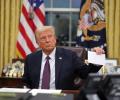
It would be a challenge to India's policy makers how to deal with Trump so that mutual economic growth remains sustained and mutual understanding on global issues are not hampered, observes Dr Rajaram Panda.
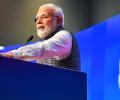
The Indian Diaspora has been able to carve a niche in their adopted countries as a result of their talent, perseverance and hardworking nature, asserts Rup Narayan Das.
The United States is persuading Islamabad that it faces a greater threat from terrorist groups which it had earlier nurtured than from India, a well known American expert on South Asia has said.
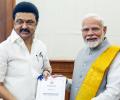
With its age-old fascination for education, southern states have done better than the North. Start-ups, IT hubs, and industry majors setting up shop have changed the face of the South. Nearly 79% of global offices set up by international conglomerates in India are in the South. Almost 46% of tech unicorns are from the South. The GDP per person in the South is 4.2 times higher than the North. None of these indicators can be ignored by any central government, whatever the political compulsions, notes Ramesh Menon.

Ms Swaraj was a conscientious woman who understood suffering and pathos and attempted in her inimitable way to mitigate them, recalls Rup Narayan Das.
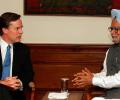
The India-US nuclear deal was aimed at ending India's nuclear isolation and nuclear apartheid, recalls Rup Narayan Das.
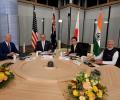
Saturday's Quad meeting in Delaware is taking place against the backdrop of China's assertive behaviour in the South China Sea, its sabre-rattling in the Taiwan Strait and increasing footprints in the Pacific and Indian Ocean, asserts Rup Narayan Das.

There is nothing to be worried about as bilateral ties are robust with solid foundations. Both are on the same page on the economic and defence/security ties bilaterally and globally and that shall continue irrespective of change in political dispensation in either country, points out Dr Rajaram Panda.

'Overlying his idealism was a hatred of war and of all things military. He gave no deep thought to politico-military matters and this prevented him from making sound security decisions.'

Russia's unprecedented rapprochement with North Korea has raised concerns about the re-emergence of a Russia-China-North Korea alliance which could increase the probability of conflict on the Korean Peninsula, explains Dr Rajaram Panda.

The trigger that led Japan and the Philippines to ink the deal was because of the deteriorating security situation in the South China Sea. China's coast guard increased the frequency and intensity of incursions into Philippine waters, provoking the Philippines to take countermeasures to deter China, explains Dr Rajaram Panda.

Engagement with neighbours is a strategic imperative, and not an option, asserts Rup Narayan Das.
 © 2026 Rediff.com - Advertise with us - Disclaimer - Privacy Policy - Sitemap - Feedback - About us - Terms of use - Grievances